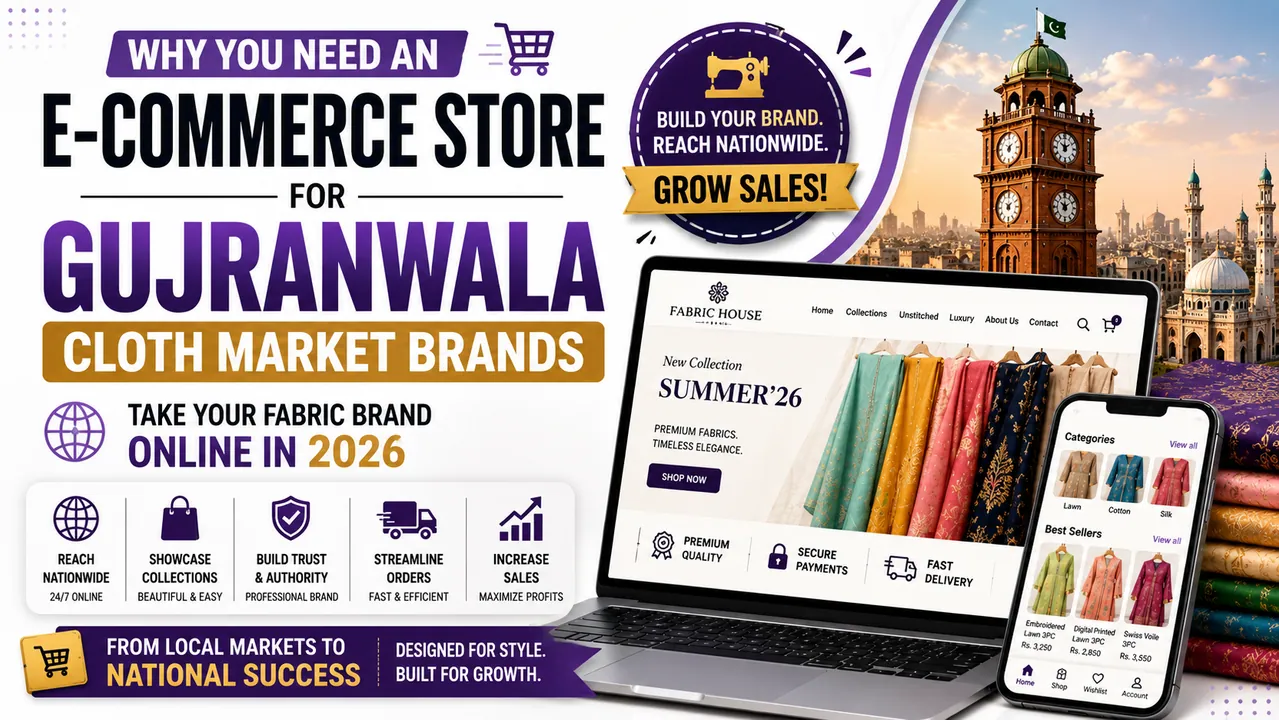

For decades, the textile sector has stood as a core pillar of Pakistan's economy, and the Gujranwala Cloth Market is one of the most prominent regional hubs for wholesale fabric distribution and retail fashion. Hundreds of local cloth merchants, embroidery creators, and unstitched fabric brands operate daily from crowded market stalls. Yet, as consumer demands shift towards digital convenience, traditional wholesale and retail fabric sellers are realizing they need a modern digital storefront. Building a secure, high-performance e-commerce store for Gujranwala cloth market brands is the ultimate strategy to establish brand authority, increase customer retention, and grow sales outside local boundaries. Moving online allows boutique owners and textile manufacturers to showcase their intricate designs to a national audience, streamline bulk and retail orders, and secure a prominent digital presence.
Why Launching an E-commerce Store for Gujranwala Cloth Market Brands is Critical
Traditional operations within physical textile markets rely heavily on seasonal buyers traveling from nearby districts. However, this localized wholesale structure faces major challenges during off-seasons, transportation issues, or local economic downturns. By launching an online e-commerce store for Gujranwala cloth market, textile brands can establish a direct line to consumers and retailers nationwide. A digital showroom allows you to showcase new winter, summer, and festive collections to buyers in Karachi, Peshawar, Quetta, and beyond. This expansion stabilizes cash flow, reduces reliance on middle agents, and allows local textile businesses to build direct brand recognition instead of remaining anonymous suppliers. It provides a platform to offer both retail purchases and structured bulk ordering systems for wholesale buyers.
Furthermore, digital-first fabric brands can launch highly targeted social media campaigns. By integrating Facebook, Instagram, and TikTok catalogs with a fast-loading e-commerce site, you can present high-definition video walkthroughs of your fabric texture, embroidery details, and styling options. When users click on these social ads, they should land on a highly optimized product page designed to convert. A dedicated online store ensures that your digital traffic is owned by your brand, shielding your customer interactions from the high commissions and fee structures of third-party multi-brand marketplaces.
Moving online also protects your textile business from local market disruptions. Physical market closures, power outages, and adverse weather conditions can halt your daily sales entirely in a brick-and-mortar setup. An online store is immune to these local physical limitations, remaining active 365 days a year to capture orders. By diversifying your sales channels with a professional digital store, you build a resilient, future-proof business model that continues to thrive regardless of local physical market conditions.
Key Features of a Premium E-commerce Store for Gujranwala Cloth Market
To successfully capture online fabric buyers, your website must offer specific features tailored to the textile industry. A premium e-commerce store for Gujranwala cloth market requires advanced filtering options that let customers sort fabric collections by material (e.g., lawn, cotton, silk, linen), type of work (e.g., printed, embroidered, hand-woven), stitching status (unstitched vs. ready-to-wear), and color variations. High-resolution imagery with multi-angle zoom features is critical to replicate the touch-and-feel experience of buying fabric in person. In addition, integrating an interactive stitching measurement form allows you to offer custom tailoring services online, which is a massive high-margin upselling opportunity for local cloth merchants.
To build a platform with these advanced features, choosing professional **web development services gujranwala** is essential. Expert developers can write clean database queries, optimize media assets so high-resolution fabric images load instantly, and integrate automated inventory updates that synchronize your online stock levels with your physical warehouse. This prevents selling out-of-stock items, which is a common issue when managing large catalogs with multiple color and size variations across wholesale and retail channels.
From a technical standpoint, this requires setting up robust database indexing and custom content delivery networks (CDNs). Fabric websites are media-heavy, containing thousands of high-definition images showing thread counts and patterns. If these images are not properly optimized and cached, your site will load slowly on mobile networks, leading to high bounce rates. Professional web developers implement image compression (WebP format), lazy-loading techniques, and server-side caching mechanisms to guarantee your website loads in under 2.5 seconds, even on standard mobile connections.
The Role of Custom Business Web Design for Textile Authority
Many local retailers make the mistake of using generic, cheap web templates to launch their online business. However, generic layouts fail to convey the quality, elegance, and premium nature of designer clothing. Professional **business web design** is critical to project authority and justify premium pricing. A tailored design system with curated typography, micro-interactions, clean layouts, and a secure checkout experience shows that your textile brand is trustworthy and established. A customized design allows you to highlight your brand's unique history, showcase customer testimonials, present styling lookbooks, and build an emotional connection with buyers that simple grid templates cannot achieve.
Custom design also ensures your website is structured correctly for search engine indexing. By using clean semantic HTML elements, optimizing meta description tags, defining canonical links, and organizing category URLs logically, your online store will rank higher on Google search results. When high-intent buyers search for fabric collections, designer suits, or wholesale unstitched clothing, your website will be positioned ahead of competitors, capturing more organic search traffic without requiring massive ad spend.
Additionally, a custom user interface (UI) enables a highly intuitive navigation path. In clothing e-commerce, user experience (UX) is everything. If customers struggle to find the search bar, category filters, or checkout buttons, they will leave your site immediately. Custom web designers construct clean, distraction-free page layouts, keep the shopping cart easily accessible at all times, and streamline the checkout form to require minimal input, resulting in higher conversion rates and maximum return on your web investment.
Integrating Pakistan-Specific Courier and Payment Logistics
Managing order fulfillment and payment collections is the operational backbone of e-commerce. Your online fabric store must support Cash on Delivery (COD) alongside secure digital payment solutions. Integrating EasyPaisa, JazzCash, and local bank payment gateways encourages prepaid orders, which minimizes Cash on Delivery returns and helps maintain healthy business capital. Your system should also connect directly to courier APIs like TCS, Leopards, and Trax. When an order is confirmed, the shipping label should be generated automatically with the correct parcel weight, and a tracking link should be sent to the customer via email or SMS, keeping them informed and reducing customer support workloads.
E-E-A-T Case Study: Launching a Fabric Brand Online in Pakistan
Consider the example of an unstitched lawn brand based in the Gujranwala Cloth Market. Traditionally operating as a wholesale fabric supplier, they decided to launch a direct-to-consumer online brand. They worked with local developers to build a fast-loading, highly secure MERN stack web catalog. By implementing clean image lazy-loading, caching product details using Redis, and optimizing for mobile viewports, the site achieved a page speed score of 92 on mobile. They launched their summer collection with high-quality zoom photos showing thread counts and embroidery details. Within three months, they processed over 4,500 retail orders, with 70% of sales coming from Karachi and Lahore. This successful transition allowed the brand to double its profit margins compared to wholesale distribution.
Frequently Asked Questions
❓ What is the best platform to build an e-commerce store for Gujranwala cloth market brands?
For most textile and cloth market brands, Shopify and WooCommerce are the best starting platforms. Shopify offers exceptional reliability, server speed, and simple catalog management, which is ideal if you want to launch quickly. WooCommerce offers maximum customization, lower transaction fees, and complete control over database schemas, which is perfect if you plan to integrate custom wholesale portals or tailor-made stitching calculators.
❓ How do I handle wholesale inquiries on my clothing website?
You can build a custom wholesale dealer portal within your e-commerce website. This allows wholesale buyers to register, log in to a secure dashboard, view discounted pricing tiers based on minimum order quantities (MOQs), and place bulk orders with custom payment terms (such as bank transfer or partial advance payment), while regular retail customers continue to view standard retail prices.
❓ How can I showcase the true color and texture of fabrics online?
To showcase fabric quality online, utilize high-resolution product photography taken under natural studio lighting to avoid color distortion. Include close-up shots showing the weave, thread work, and texture. Adding short 10-second video loops of models wearing the stitched fabric allows buyers to see how the material drapes and moves in real life, significantly boosting their buying confidence.
❓ What measures should I take to prevent Cash on Delivery returns?
To minimize Cash on Delivery (COD) return rates, implement an automated WhatsApp or phone call order verification step before shipping parcels. Clearly display sizing charts and fabric details to prevent customer mismatch. You can also offer small discounts or free shipping incentives for customers who choose to pay online via bank transfer, EasyPaisa, or credit card at checkout.
Conclusion and Next Steps
Moving your fabric brand online is the single most effective way to secure a competitive edge and expand beyond local limits. A premium online store helps you build brand authority, increase customer lifetime value, and drive sales nationwide. To explore custom web solutions designed to scale your brand, visit the About Mian Adil page to learn more about my background, or head to the Contact Page to request a free consultation and get a custom quote for your cloth store.
Turn These Insights Into Results
Choose the most relevant next step for your website or online business.
- E-Commerce Website Development Launch a fast, secure online store designed for sales and growth.
- Get a Free E-Commerce SEO Audit Check search visibility, speed, and conversion-critical website issues.
- Explore Mian Adil’s Portfolio See web development, SEO, e-commerce, and SaaS work in one place.