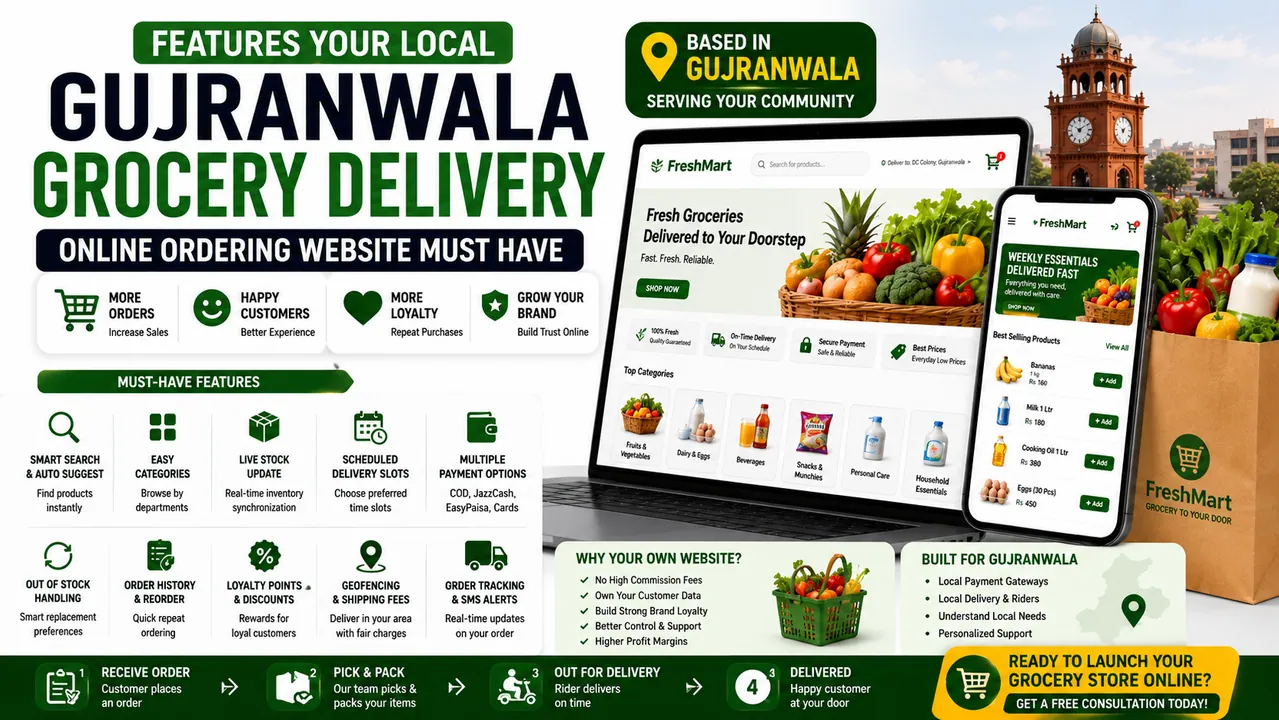

Consumer shopping habits in Pakistan have shifted dramatically toward digital convenience. From major metropolitan hubs to active commercial cities like Gujranwala, families are choosing to order their daily essentials, fresh fruits, vegetables, and household goods online. For local supermarkets and grocery store owners, launching a dedicated digital storefront is the most effective way to protect your market share and reach new clients. However, launching a basic webpage is not enough; you need a feature-rich, high-performance online ordering website that can handle thousands of product listings, manage delivery time slots, and process payments securely. In this comprehensive guide, we will analyze the non-negotiable features your grocery site must have to dominate the local market.
Why a Dedicated Online Ordering Website is Essential for Local Grocers
Many local grocers rely on third-party food and grocery delivery aggregators to sell online. While these platforms offer quick setup, they charge high commissions (often between 15% and 25% per order), control your customer data, and display your competitors right next to your listings. Building your own independent online ordering website allows you to reclaim control over your brand, eliminate commission fees, and build direct relationships with your buyers. By offering custom loyalty points, personalized discounts, and direct customer support, you turn one-time shoppers into highly profitable, repeat clients. This independence is essential for long-term survival in the digital retail landscape.
Additionally, grocery shopping is a high-frequency activity. Unlike buying clothes or electronics, customers purchase groceries weekly or even daily. A dedicated web platform allows you to optimize the user journey specifically for repeat purchases. Features like order history replication, favorite item lists, and smart search predictions make it incredibly easy for busy customers to complete their weekly shopping in under five minutes, driving long-term customer retention and higher average order values. Keeping the platform direct also ensures you control the delivery experience, which is the final physical touchpoint with your brand.
Essential Features for a Grocery Delivery Online Ordering Website
To provide a premium user experience, a local grocery portal must include several specialized functionalities. The most important is a smart search and auto-categorization engine. Since grocery stores stock thousands of products across different departments (dairy, fresh produce, snacks, personal care), customers must be able to find items instantly. Implementing an autocomplete search bar that suggests products as the user types helps buyers locate goods quickly. Visual category grids also make browsing intuitive for users who prefer navigating through sections rather than typing. Fast indexing is critical here to ensure instant results.
Another critical feature is a flexible delivery scheduling system. Unlike general e-commerce shipping, grocery buyers want to choose exactly when their orders arrive. Your checkout system should allow users to select specific time slots (e.g., 10:00 AM - 12:00 PM, or evening delivery) and specify delivery instructions. Integrating local mapping APIs also ensures that delivery riders can locate customer addresses in dense Gujranwala residential areas (such as DC Colony, Wapda Town, or Satellite Town) without constant phone coordinates requests, reducing delivery delays.
The Importance of Custom Web Application Development for Complex Inventory
Managing inventory for a grocery store is a major challenge. Product prices fluctuate daily, items sell out quickly, and many products (like fresh vegetables and meats) are sold by variable weight rather than fixed units. Standard e-commerce templates are not built to handle these complex requirements. This is where custom web application development becomes invaluable. A custom-built admin panel allows store managers to update prices in bulk using CSV files, set up dynamic stock alerts, and adjust weights at checkout after the items are physically weighed in the store.
Furthermore, custom development allows you to integrate your web system with your in-store Point of Sale (POS) software. This ensures that when a product is sold physically in the store, the digital catalog updates automatically, preventing online customers from buying out-of-stock items. Custom platforms also load much faster, handle large database queries efficiently, and provide robust security features that protect your transaction data and client profiles from unauthorized hacking attempts. This technical integration is the foundation of a modern, automated retail business.
Handling Out-of-Stock Items and Product Replacement Logic
In grocery e-commerce, items frequently go out of stock during the day. How your website handles these scenarios directly impacts customer satisfaction. During the checkout process, the user interface should present clear replacement preferences. For example, customers can choose to: 'Replace with the closest alternative,' 'Call me to confirm the replacement,' or 'Do not replace and refund the item.' This logic must be built into the order processing backend.
When the warehouse picker finds an item is out of stock, they update the order status via a picker mobile app. The website's automated system then executes the customer's predefined replacement preference, recalculating the invoice totals and notifying the customer via email or SMS. This automated communication avoids customer frustration, maintains billing accuracy, and ensures that deliveries are not delayed due to out-of-stock items.
Geofencing and Distance-Based Shipping Fee Calculations
Grocery delivery is geographically limited. Delivering ice cream or fresh dairy to a location 30 kilometers away is logistically unfeasible and expensive. To manage these constraints, your online store must implement geofencing. Using mapping API integrations, developers define delivery boundaries on a map. When a customer enters their delivery address, the system checks if the coordinates fall within the geofenced zone. If they are outside the zone, the checkout is blocked, preventing unfulfillable orders.
Additionally, the system can calculate dynamic shipping fees based on the exact distance between the supermarket and the delivery location. For example, delivery within a 3km radius could be free, while delivery between 3km and 8km incurs a tiered shipping fee. This automated calculation protects your delivery margins while ensuring fair pricing for local customers, making your grocery operations sustainable and profitable.
Finding the Right Web Builder Near Me for Local E-commerce Success
Building a successful digital platform requires collaborating with a technical specialist who understands the local business landscape. Searching for a reliable web builder near me ensures that you can work closely with a developer to define your project scope, run on-site training for your staff, and receive ongoing technical support. A local developer is also familiar with the local payment methods (such as EasyPaisa, JazzCash, and local bank transfers) and courier integrations that are popular in Pakistan, ensuring that your technical setup is tailored for local buyers.
Working with a local expert also means you have access to quick troubleshooting. If your payment gateway experiences issues or your database goes offline during a busy holiday sales period, having a technical partner in your time zone ensures that problems are resolved immediately, preventing revenue losses and protecting your brand reputation. A dedicated local developer will help you design, launch, and optimize your web application to drive sustainable business growth.
Optimizing the Checkout Flow for Mobile Grocery Shoppers
Since the majority of local buyers will access your store via mobile devices, your mobile checkout flow must be highly optimized. Complex forms with unnecessary fields cause immediate cart abandonment. The checkout should be a single-page layout that collects only essential information: name, phone number, shipping address, and preferred delivery time. Implementing a phone number verification step via SMS OTP ensures that you collect verified customer contacts, protecting your business from fake orders and shipping losses.
Additionally, the cart interface should allow users to add or subtract item quantities with a single tap, without reloading the page. Providing clear, transparent shipping fees and minimum order requirements upfront prevents surprises at the final payment step. A frictionless, fast-loading mobile checkout ensures that you capture busy homemakers and working professionals who value speed and convenience, maximizing your digital store's order conversion rates.
Case Study: Scaling a Local Gujranwala Grocery Store Online
Let us look at a real-world example of a supermarket in Gujranwala that decided to launch its own grocery delivery platform. Previously, they relied entirely on phone calls and WhatsApp to take home delivery orders, which resulted in mismatched items, order backlog, and delivery delays. They hired a local custom developer to build an online ordering website with live inventory tracking and SMS status notifications. Within three months, they automated their ordering system, processed over 1,500 monthly orders online, reduced order errors to under 1%, and increased their average order value by 30% thanks to smart product recommendations at checkout.
Frequently Asked Questions
❓ What is the advantage of building an independent online ordering website over using third-party delivery apps?
An independent website allows you to eliminate expensive commission fees (15% to 25%), own your customer database, build brand loyalty, and control the entire customer experience. You can run custom marketing campaigns, offer targeted loyalty rewards, and showcase your products without competing brands appearing on the same page.
❓ How does a grocery website handle variable-weight items like fresh produce or meat?
Custom websites manage variable-weight items by allowing customers to add estimated weights to their cart (e.g., 1 kg of chicken). The system pre-authorizes the payment or estimates the COD bill. Once the order is packed and the exact weight is recorded in the warehouse, the system updates the final invoice and charges the exact amount, keeping transactions honest.
❓ Can I offer multi-slot scheduled deliveries on my grocery website?
Yes. A custom-built platform can include delivery slot management. You can define specific delivery windows, set maximum order limits per slot to prevent overloading your delivery riders, and temporarily disable specific slots once they are full, ensuring that you always meet your delivery commitments.
❓ What payment methods should a local grocery website in Pakistan support?
A local grocery website should support Cash on Delivery (COD) as the primary option, alongside mobile wallets like EasyPaisa and JazzCash, and local debit/credit card processing. Offering diverse payment options ensures that you accommodate all customer preferences, maximizing checkout completions and customer convenience.
Conclusion and Next Steps
Launching a dedicated grocery delivery website is a powerful strategy to scale your retail business, automate order processing, and capture the growing digital market in Gujranwala. By incorporating essential features like smart search, scheduled deliveries, and POS integrations, you build a premium store that drives customer satisfaction. To explore how custom web solutions can digitalize your grocery business, visit the About Mian Adil page to review my development background, or head to the Contact Page to schedule a free technical consultation and request a custom quote. Let's build a platform that automates your retail success.
Turn These Insights Into Results
Choose the most relevant next step for your website or online business.
- E-Commerce Website Development Launch a fast, secure online store designed for sales and growth.
- Get a Free E-Commerce SEO Audit Check search visibility, speed, and conversion-critical website issues.
- Explore Mian Adil’s Portfolio See web development, SEO, e-commerce, and SaaS work in one place.