
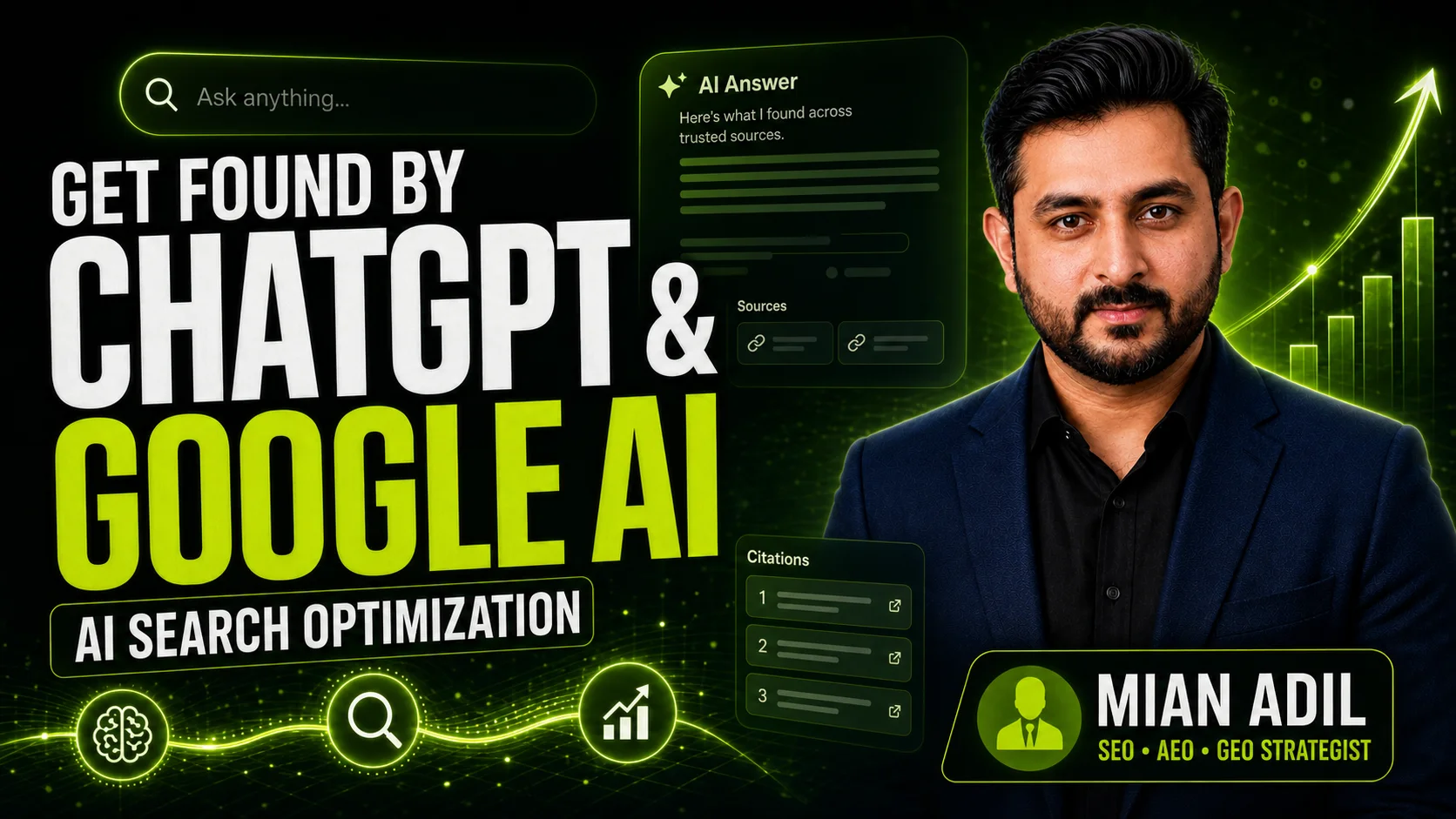

When someone asks ChatGPT or Google AI to recommend a business in your industry, does yours appear? If not, you may be invisible to a growing share of potential customers. AEO (Answer Engine Optimization) and GEO (Generative Engine Optimization) are designed to improve that visibility.
AEO services in Pakistan help businesses make their content easier for answer engines to understand, extract, trust, and reference. Generative Engine Optimization, or GEO, extends that work to AI-generated experiences such as Google AI Overviews and AI Mode, Microsoft Copilot, Perplexity, Gemini, and other systems that retrieve information from the open web. The practical goal is not to chase a secret AI-ranking trick. It is to publish crawlable, expert-led, well-supported content that answers real questions and gives both people and machines a clear reason to trust your brand.
What Are AEO and GEO?
Answer Engine Optimization (AEO) is the process of structuring content so it can provide a clear, useful answer to a specific question. AEO focuses on direct definitions, concise answer blocks, logical headings, steps, comparisons, costs, limitations, FAQs, and supporting evidence. The page still needs to serve a human reader; the structure simply makes the answer easier to locate and understand.
Generative Engine Optimization (GEO) focuses on improving the probability that generative search systems can retrieve, summarize, mention, or cite a page. It combines conventional SEO with entity clarity, source-worthiness, author expertise, consistent facts, third-party reputation, and content that adds something original instead of recycling generic advice.
Google's official guidance is especially important here. Google states that its generative AI features are rooted in core Search ranking and quality systems, and that established SEO practices remain relevant. It also warns against unsupported AEO/GEO hacks, unnecessary pages for every query variation, and commodity content that merely repeats what already exists. In other words, generative engine optimization in Pakistan should be treated as disciplined SEO for a changing search interface—not as a separate scheme that bypasses quality.
Traditional SEO vs AEO vs GEO
| Discipline | Main objective | Typical work | Useful measurement |
|---|---|---|---|
| Traditional SEO | Earn qualified organic visibility | Crawlability, indexing, content, links, local SEO and page experience | Impressions, clicks, rankings and leads |
| AEO | Become a clear answer | Answer blocks, definitions, steps, comparisons, FAQs and structured sections | Featured results, question-query visibility and engagement |
| GEO | Become a trustworthy source for generative answers | Entity signals, original insight, citations, proof, freshness and reputation | Verified AI mentions, cited URLs, referral traffic and assisted leads |
These disciplines overlap. A page that is blocked from crawling will not become a reliable Google AI source. A page that ranks but gives vague answers may not satisfy conversational queries. A polished answer without evidence may be easy to summarize yet unsafe to cite. Effective AI search optimization therefore works as one connected system.
Why AI Search Matters for Pakistani Businesses
Conversational searches combine price, trust, location, expertise, and risk. An AI-search-ready page answers the whole decision: who the service is for, what is included, how the process works, what proof exists, what limitations apply, and how to proceed.
The opportunity is real, but measurement must remain honest. Microsoft introduced an AI Performance section in Bing Webmaster Tools that reports citations, cited pages, and grounding queries across supported AI experiences. Microsoft explicitly notes that citation counts do not represent ranking or page importance. This is the right mindset: measure observable references and business outcomes instead of selling vague promises about “dominating AI.”
What Professional AEO Services in Pakistan Include
1. Technical discovery and crawlability
The work begins with a crawl of the website, sitemap, robots rules, canonical tags, status codes, JavaScript rendering, duplicate URLs, internal links, mobile usability, and page speed. A page must be accessible, indexable, and eligible to appear with a snippet before Google can consider it for generative Search experiences. Important service information should be present in crawlable HTML rather than hidden behind fragile client-side interactions.
2. Question and conversation mapping
Keyword research is expanded into full customer conversations. For each commercial topic, the strategy maps the main question, follow-up questions, cost concerns, trust concerns, comparisons, risks, and action questions. Similar queries are grouped into one strong page rather than spread across thin articles. This cluster approach reduces cannibalization and gives the reader a complete resource.
3. Answer-first content architecture
Important pages receive a concise answer near the top, followed by context, steps, examples, comparisons, evidence, limitations, FAQs, and a relevant call to action. Headings describe what each section actually answers. Tables are used when they make choices clearer, not simply to decorate the page. The writing remains natural because modern systems understand related language without forcing every keyword variation.
4. Entity and schema alignment
AI systems need consistent information about the business and the people behind it. An entity review checks the brand name, founder, expertise, location, services, official profiles, contact details, portfolio, reviews, and author pages. Appropriate Person, Organization, LocalBusiness, Service, Article, and Breadcrumb structured data can reinforce visible facts. Schema is not a special AI-ranking button, and it should never describe claims that users cannot see on the page.
5. Proof and source-worthiness
Strong proof includes real projects, transparent methodology, author credentials, dated updates, customer reviews, original observations, and primary sources. Mian Adil's projects portfolio, client reviews, and professional About page provide internal evidence without manufacturing achievements.
6. Reputation and third-party consistency
GEO does not stop on the website. Official profiles, relevant directories, authentic reviews, interviews, guest articles, and community contributions can help confirm that an entity is real and associated with a topic. The objective is consistency and useful third-party evidence—not mass-produced mentions, paid praise, fake reviews, or repeated exact-match anchors.
7. Monitoring and iteration
Measurement should combine Google Search Console, Bing Webmaster Tools, analytics, tracked conversions, and repeatable manual checks across selected AI systems. Teams can monitor whether important pages are indexed, which questions gain impressions, which URLs receive citations where reporting exists, and whether AI-search referrals produce enquiries. Because answer systems change rapidly, quarterly content verification is more useful than a one-time “optimization” package.
A Practical AEO and GEO Implementation Process
- Baseline audit: identify technical blockers, existing winners, missing commercial pages, entity gaps, and conversion friction.
- Priority map: select high-value services and group same-intent questions into one primary URL per cluster.
- Content brief: define the direct answer, required sections, proof, sources, internal links, schema, CTA, and limitations.
- Page production: write or improve crawlable content with expert input, clear formatting, original examples, and relevant visuals.
- Entity connection: align author, organization, service, review, project, and official-profile signals.
- Quality assurance: validate facts, links, metadata, structured data, mobile rendering, accessibility, and page performance.
- Measurement: track search visibility, citations where supported, qualified visits, assisted conversions, and leads.
This process works best when SEO, content, development, and brand proof are handled together. Publishing FAQs alone is not an AEO strategy, and adding an llms.txt file alone is not a GEO strategy. Google now states that llms.txt is not needed for its Search generative AI features and neither helps nor harms Google rankings. Businesses may maintain such files for other systems, but they should not replace crawlable HTML, strong information architecture, or verified expertise.
How Much Do AEO and GEO Services Cost in Pakistan?
Pricing depends on site size, technical condition, competition, content needs, and analytics access. A small site may need an audit plus priority upgrades; a national brand may require technical fixes, entity work, content clusters, authority building, and ongoing measurement. A credible proposal should separate these deliverables. Avoid guaranteed ChatGPT mentions, guaranteed AI Overview placement, instant “AI citations,” or fixed ranking deadlines.
A credible proposal should separate discovery, implementation, content production, development, authority work, and monthly monitoring. It should also state what is not included. Be cautious when a provider sells guaranteed ChatGPT mentions, guaranteed AI Overview placement, hundreds of instant “AI citations,” or a fixed ranking deadline. No consultant controls how independent search and answer systems select or present sources.
Common AEO and GEO Mistakes
- Creating one page for every keyword variation: this produces thin content and can make multiple URLs compete for the same intent.
- Writing for bots instead of customers: awkward definitions and repetitive phrases reduce trust and satisfaction.
- Publishing unverified statistics: unsupported numbers make a page risky to cite and damage credibility.
- Ignoring technical SEO: excellent answers cannot perform reliably when crawling, canonicalization, or rendering is broken.
- Using schema as hidden advertising: structured data must match visible, truthful content.
- Buying fake authority: fabricated reviews and irrelevant link networks create reputation and spam risk.
- Tracking mentions without leads: visibility is useful only when it contributes to qualified discovery, trust, or conversion.
Frequently Asked Questions
❓ What is the difference between AEO and GEO?
AEO makes a page better at answering specific questions clearly. GEO strengthens the wider signals that may help generative systems retrieve, summarize, mention, or cite that page. In practice, both depend on sound SEO, useful content, clear entities, and credible evidence.
❓ Can AEO guarantee that my business appears in ChatGPT or Google AI?
No. AEO and GEO can improve crawlability, clarity, source-worthiness, and the probability of being understood or referenced, but no provider can guarantee selection by an independent AI or search platform.
❓ Do I need a separate page for every AI-search keyword?
No. Closely related keywords with the same intent should normally be combined into one comprehensive page. Separate pages are appropriate only when the user intent, audience, service, location, or required answer is meaningfully different.
❓ Is traditional SEO still required for generative search?
Yes. Google's official guidance says its generative AI Search features rely on core Search ranking and quality systems. Indexability, crawlability, helpful content, internal links, page experience, and trustworthy authority remain foundational.
❓ How long does AI search optimization take?
Technical and content improvements can be implemented within weeks, but discovery, indexing, reputation growth, citations, and lead impact do not follow a guaranteed timeline. Progress should be reviewed over several months using verified search and conversion data.
Start with Evidence, Not AI Hype
The best AEO services in Pakistan do not replace SEO with trendy terminology. They make a business easier to discover, understand, trust, and choose across both conventional and generative search journeys. That requires clear answers, technically accessible pages, original expertise, honest proof, consistent entities, relevant authority, and measurement tied to real enquiries.
If you want to identify which pages, questions, and entity signals deserve attention first, request a free SEO and AI-search readiness audit. The review can reveal crawlability issues, content gaps, AEO opportunities, GEO proof gaps, and the highest-value next actions without promising outcomes that no agency can control.
Primary Sources
- Google Search Central: Optimizing for generative AI features
- Google Search Central: Helpful, reliable, people-first content
- Bing Webmaster Blog: AI Performance in Webmaster Tools
- Perplexity Help Center: How Perplexity works
Turn These Insights Into Results
Choose the most relevant next step for your website or online business.
- Get a Free SEO & AI Search Audit Find the technical and visibility gaps holding your website back.
- SEO-Ready Web Development Build a faster, conversion-focused website with a clean technical foundation.
- Explore Mian Adil’s Portfolio Explore AI automation with supporting websites, SEO and clearly labelled project evidence.